
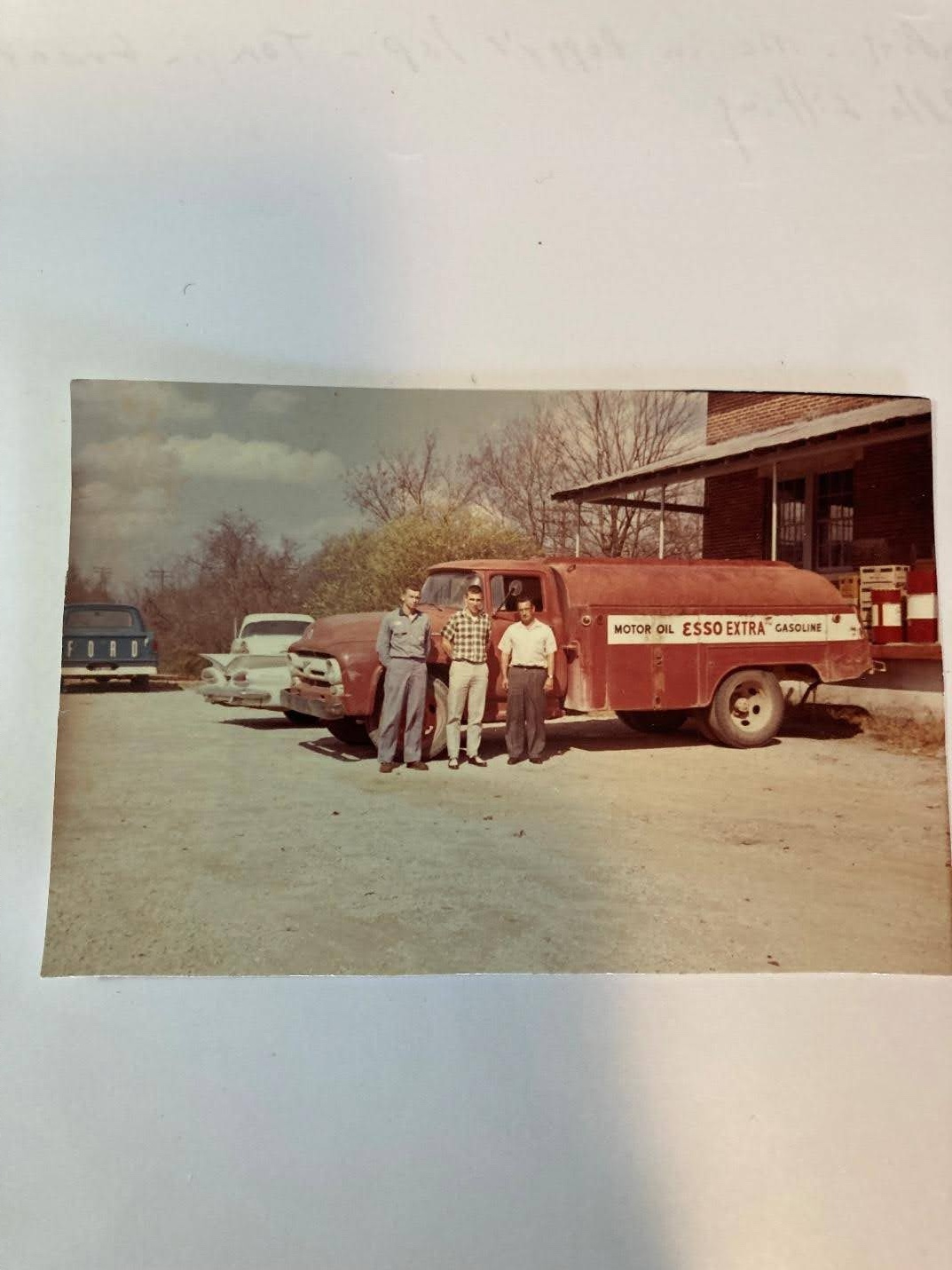
The unremarkable office, home to two ancient wooden desks, collapsing file cabinet and ever-present aroma of oil emanating from the uniforms worn by Glenn Ray and his two employees, looked out over two weathered fuel delivery trucks parked in the gravel parking lot. Each one, rusty red and blue, covered in dust and grime, carried the Esso insignia and his name on the doors. Next to them stood three imposing tanks holding thousands of gallons of fuel in each; premium, regular and diesel. On this sub-freezing January morning, Glenn Ray pulled on his corduroy jacket, adjusted his ball cap, tightened his bootstrings, took the keys off the nail by the door, popped open a bottle of Coca Cola and headed to the nearest truck filled with today’s delivery.
Approaching the truck, he set the Coke down by the front tire, opened the door, stepped up into the cab and worked the key until the motor grudgingly turned over. Letting the motor idle, he jerked up the hand brake, pulled on his leather gloves, stepped outside, picked up the Coke and commenced to pour the contents over the windshield. Smiling as he watched the ice disappear, he wondered yet again how much damage this must do to a man’s stomach if it eats up snow, ice and grime so effectively.
He needed no written schedule today. He knew his route. First to Bob Brown’s farm to top off his small tank of tractor fuel. Then to William Flemings’s newly opened gas station to fill his underground tanks. Finally, over to visit a fellow Esso distributor in a nearby county to take a look at his facility, especially the newly paved parking lot he had heard so much about.
He knew Bob Brown and his family since high school days, and always looked forward to visiting with him. Approaching the cattle crossing bordering Bob’s farm, Glenn Ray smiled and shook his head, as he knew that the cost of the trip out into the country to fill up Bob’s small tank exceeded his profit from the delivery. Parking just next to the tank, he climbed down from the cab and immediately fixated on Bob’s lone bull eagerly licking grease off the nearby tractor axle.
While inserting the hose into the tank, Bob appeared from around the barn and Glenn Ray proceeded to rib him mercilessly about the new slick nourishment Bob fed his cow, and how he couldn’t wait to see the vet bill. After a few minutes of back-and-forth insults and arm slapping, they said their cheerful goodbyes, with neither discussing the cost of the delivery nor the expectation of a coming bill. Somehow that would all work out, and hopefully he would break even. But maybe not. He would return in about a month to fill it up again.
The return trip took him to the crossroads between the white and black neighborhoods of his Tennessee hometown. William’s gas station was just inside the white line, and Glenn Ray reflected on how William became the first Black owner of a gas station on this side of town. When the original owner died, William drove to his office and told him he had saved up some money and wanted his approval to buy the place. Glenn Ray, while impressed by William’s work as a gas jockey and mechanic under the previous owner, was taken aback and unsure how to respond. He told him he would think about it. He talked to competing oil distributors, to friends from church, to the mayor, to his family. All but one advised against giving William this chance. Over and over, he heard a variation of the same refrain: “it’s not time, not now, maybe not ever. Even though that Civil Rights Bill just passed, it’s just not time here.” Everyone except his wife Peggy, whose only question was, “Is he a hard worker, do you trust him?” And that was that.
William took over the station just one week ago and he already needed the diesel tank refilled. Getting out of the truck Glenn Ray nodded to William, pulled down the thick hose, unhooked the cover to the underground tank, and deposited the fuel. As William approached the truck, each of them pulled off their gloves and shook hands. Then they talked cold weather fishing. As Glenn Ray secured the hose back on the truck, William thanked him again for this chance. Well, Glenn Ray replied with an easy smile, “I trust you’ll get this place going and make us both some money.”
The last stop was at the Esso distributorship just across the county line, owned by Harold Harvey. Both Glenn Ray and Harold started their businesses at the same time, but he heard murmurings from Esso executives that Harold moved quicker out of the gate. Pulling into the newly paved parking lot, he marveled at the cleanliness of Harold’s trucks and the sparkle on the smooth asphalt pavement. Walking through the front door, he sat down in a newly furnished office showcasing expensive wood paneling, a new wooden floor, two new desks and chairs, and stylish windows overlooking the parking lot. For a while they talked about the cold, but not for long.
Standing up and walking around the office, staring out into the parking lot without turning to face Harold, Glenn Ray asked how he could afford all this. Easy, Harold offered. The fellows he hired to pave his parking lot just wrote up a bill overstating the actual price by a few thousand dollars. Then, he said, he sent that up to the regional Esso headquarters, which reimbursed him their pre-approved percentage of the bill. The overpayment then allowed him to pay off his portion for the paving and fix up the office with what was left. Awash in his own cleverness, he told Glenn Ray he’d introduce him to his pavers. “Don’t be a fool,” he said, “those Esso guys never check.”
Glenn Ray paced around the office, mumbled something about what a nice facility Harold had, turned the conversation back to the weather for a few awkward minutes, then nodded, saying he had to run. Climbing back into his truck he glanced at himself in the rearview mirror, released a long, slow sigh, mumbled “I can’t do that,” and headed back to his own proud but untidy facility. An hour later he parked the truck in his gravel lot, walked through the office door, hung the keys back on the nail, took off his jacket and cap, warmed his hands by the space heater between the two desks, and laughed on and off all afternoon with Hugh, his office manager, about the multiple uses of a perfectly good bottle of Coca Cola.
Edgar A. Porter is a writer of fiction and non-fiction. He is the author of six books, two of which have been translated and published in Japan and China. His memoir, From Calvin to Mao and Beyond was published in 2023. His most recent works of fiction appear in The Milk House and County Lines, A Literary Journal. He currently resides in Aiea, Hawaii.