
Disclaimer: This article talks about Northern Ireland (NI), the movie Kneecap, and the hip-hop group of the same name. I am an American who lived in Belfast for a short time and researched NI but I am not an expert or scholar.
Kneecap, the hip-hop group from Belfast, Northern Ireland (NI),[1] are engaging in the struggle for a united Ireland in a way that their parents never did – through sex, drugs, rock ‘n’ roll, and a sense of humor. They are also engaging in Palestine’s struggle which they see as parallel to Northern Ireland’s.
In the past few years, the members of Kneecap have been charged with terrorism, they’ve been told by the British Prime Minister not to play at a music festival in England, they’ve been banned from at least two countries (Canada, Hungary), they’ve made a movie based on their lives, and they are the first Irish language hip-hop group to rock the world.
You gotta love these guys.
Kneecap is made up of three men from Belfast: Liam Óg Ó hAnnaidh, Naoise Ó Cairealláin and J. J. Ó Dochartaigh aka Mo Chara, Móglaí Bap, and DJ Próvaí. The movie Kneecap (2024) was directed by Rich Peppiatt and written by Peppiatt and the Kneecap members. It is a semi-biographical (and tongue-in-cheek) account of their lives.
Kneecap’s Northern Ireland
It’s impossible to understand Kneecap (the group or the movie), without understanding some history of the United Kingdom (UK), Northern Ireland (NI), and the Republic of Ireland. There is now, and has been for centuries, tension between the Protestants and the Catholics in NI. While this sounds like it’s based in some theological disagreement about something Martin Luther or the pope said, or whether Henry VIII could marry Anne Boleyn; it’s not really about that. It’s really about economics and race.
It all started in 1603 when Protestants from Britain came to the island of Ireland and established colonies. (We all know how that usually turns out.) These Protestants saw the native Irish, who also happened to be Catholic, as “racially inferior.”[2] For centuries, then, those in power used, and still use, this idea of “race” as a form of political control, with British/Protestants having all or most of the control and Irish/Catholics losing out.[3]
The Catholics didn’t succumb easily. In 1921, as a result of the Irish War of Independence, the Irish Free State (Republic of Ireland) was born and gave home-rule to most of Ireland, except for the six counties in the northeast (called Northern Ireland), which continued to be ruled by Britain.
Starting in the 1960s, “the Troubles” raged in Northern Ireland. The republican (Catholic) insurgents (e.g., the Irish Republican Army) fought loyalist[4] (Protestant) police forces, paramilitary groups, and the British military. Thousands of people died in police shootings, executions, bombings, and street fights. While republican insurgency is complex, perhaps the most legendary version of it was the Provisional IRA, which split off from the Original IRA in 1969. The “Provos” as they were called, adopted an urban guerrilla warfare style, and eventually gained control over the IRA’s political wing, Sinn Féin (pronounced “shin-FAIN”) which literally means “We, Ourselves.”[5] (The stage name DJ Próvaí is a nod to the Provos.)
The Troubles subsided only when a peace agreement was signed on Good Friday, 1998. After that, a tense, but mostly non-violent peace ensued. Between 2005 and 2010, the IRA and many loyalist groups “decommissioned” arms by going through a verification process of destroying guns and other weapons. Today, there are “dissident republicans” in splinter groups who claim the mantel of “IRA.” However, they are relatively small and have limited power and influence.
Yet, the history of the violence is still present everywhere. In Belfast, you can now take a walking or “Black Taxi” tour on the history of the Troubles. Both tours take you to the “peace walls” that were built during the Troubles and still stand today to separate Catholic and Protestant neighborhoods. The gates in the wall are open in the daytime but close at 6:00 p.m. Although you can get to the neighborhood on the other side by taking a detour around the wall, most avoid it at night.
Waking the “Ceasefire Babies”
So much of the history of NI and where it stands today – still under British rule – directly informs the Kneecap ethos. Yet, while they want a home-ruled Ireland, Kneecap are not the republicans of the Troubles. They both embrace their republican predecessors and poke fun at them simultaneously. They, and many of their fans, are “ceasefire babies” — born around the time of the 1998 ceasefire — who grew up in the shadow of the Troubles, but were not there themselves.
Kneecap’s Chara and Bap were not born when the peace agreement was signed and Próvaí was just a young child.[6] Although they weren’t around for the Troubles, the cohort of ceasefire babies are facing generational trauma, poverty, high rates of suicide, and continued sectarianism (e.g., only 7% of schools were integrated Catholic and Protestant as of 2019, walls separate the neighborhoods, etc.). They’ve grown up with the idea that the two sides don’t mix. “[A] lot of people are so blasé about sectarianism. They don’t see that you can dismantle sectarianism and that it’s something that’s worth working towards,” said a 20-year-old student about their generation.[7] Many of the young people I met in Belfast seemed to be on the same page. We’ve got peace. Enough is enough. I just want a life and have a good job. It’s not that I don’t care, I just want to move on from our heavy history.
This is the context that gives rise to Kneecap. And whether it’s intentional or not, Kneecap and Kneecap are raising the political consciousness of the ceasefire generation through history, language, sex/drugs/rock ‘n’ roll and humor.
Lest they forgot their historical roots, Chara and Bap’s solemn on-screen mother (Simone Kirby) and father (Michael Fassbender) appear in the movie to remind us that the Troubles are only one generation away. The father is in hiding due to his former involvement with the IRA and we see Chara being baptized by the light of police helicopters because of it. Although the Royal Ulster Constabulary (RUC), the homegrown police that stalked the IRA and tried to subjugate Catholics – has been gone for years, Kneecap lyrics mention them as “unwelcome” at the party (see lyrics below). Even the band’s name comes from the punishment called “kneecapping” — shooting a person’s kneecap as a punishment for a crime not in keeping with the IRA’s wishes.
Lyrics to Kneecap’s best-known song are shown below (in Irish and English).
| C.E.A.R.T.A. Foc mi, ní fhaca mé na bastairdí Carr dubh ina bhfolach ar ár mullach is iad taobh istigh Seans ar bith, go bhfaighidh siad mo mhála MD Mar tá cóisir ann anocht ’s níl fáilte roimh an RUC | R.I.G.H.T. Fuck me, I didn’t see the bastards coming A black car hidden on the hill and them inside No chance at all they’ll get my bag of MD Because I have a party tonight and the RUC aren’t welcome. [8] |
Language is a big deal in Northern Ireland, to put it mildly, and speaking Irish is another way that Kneecap has made a name for themselves.[9] Language is an important element of any culture and the suppression of language has always been a tool of colonizers, and use of native languages a weapon of the colonized. During the Troubles, incarcerated IRA members spoke in Irish to bamboozle the monolingual English-speaking guards. In 2017, Kneecap became the first hip-hop group to rap in Irish perhaps, at least in part, because Próvaí was an Irish language teacher (in real life and in the movie) when they started. It was a few years later that the Identity and Language (NI) Act 2022, the Irish language was finally recognized as a legitimate language by the NI government.[10]
Another big theme for Kneecap is sex, drugs, and rock ‘n’ roll. Especially the drugs. In one interview (in real life), Bap explained “we’re political, but it’s very tongue-in-cheek. We wanted to take the seriousness and the sting out of it and incorporate elements of life that we as young people enjoy—like partying and taking Class A drugs.”[11] The lyrics to C.E.A.R.T.A. shown above mention “MD” which is short for MDMA, also known as “molly” or “ecstasy.” In the movie, disapproving older men show up as a group called Radical Republicans Against Drugs (RRAD) to confront our heroes about selling drugs. Chara and Bap narrowly escape punishment for the crime, which during the Troubles could have resulted in IRA members inflicting a punishment on them. Yep, back then, they could have been kneecapped. Spoiler alert: our lads get away unscathed.
Then there is Kneecap’s/Kneecap’s wild sense of humor. I know it sounds like it wouldn’t be something to joke about, but the movie has a lot of fun with the Catholic-Protestant tension. When Chara encounters a group of orange-clad loyalist Protestants having a little parade, he steals their baton and narrowly avoids getting his ass kicked. Georgia, Mo’s girlfriend (fuckbuddy?), is Protestant and sports a tattoo of the Red Hand of Ulster on her back, a symbol associated with loyalists. During sex, Georgia yells out “Northern Ireland!” the name preferred by loyalists. True to form, Chara yells back the republican name, “the north of Ireland!” There are numerous republican and loyalist slogans that these two trade while in the throes of passion.
Free Ireland, Free Palestine
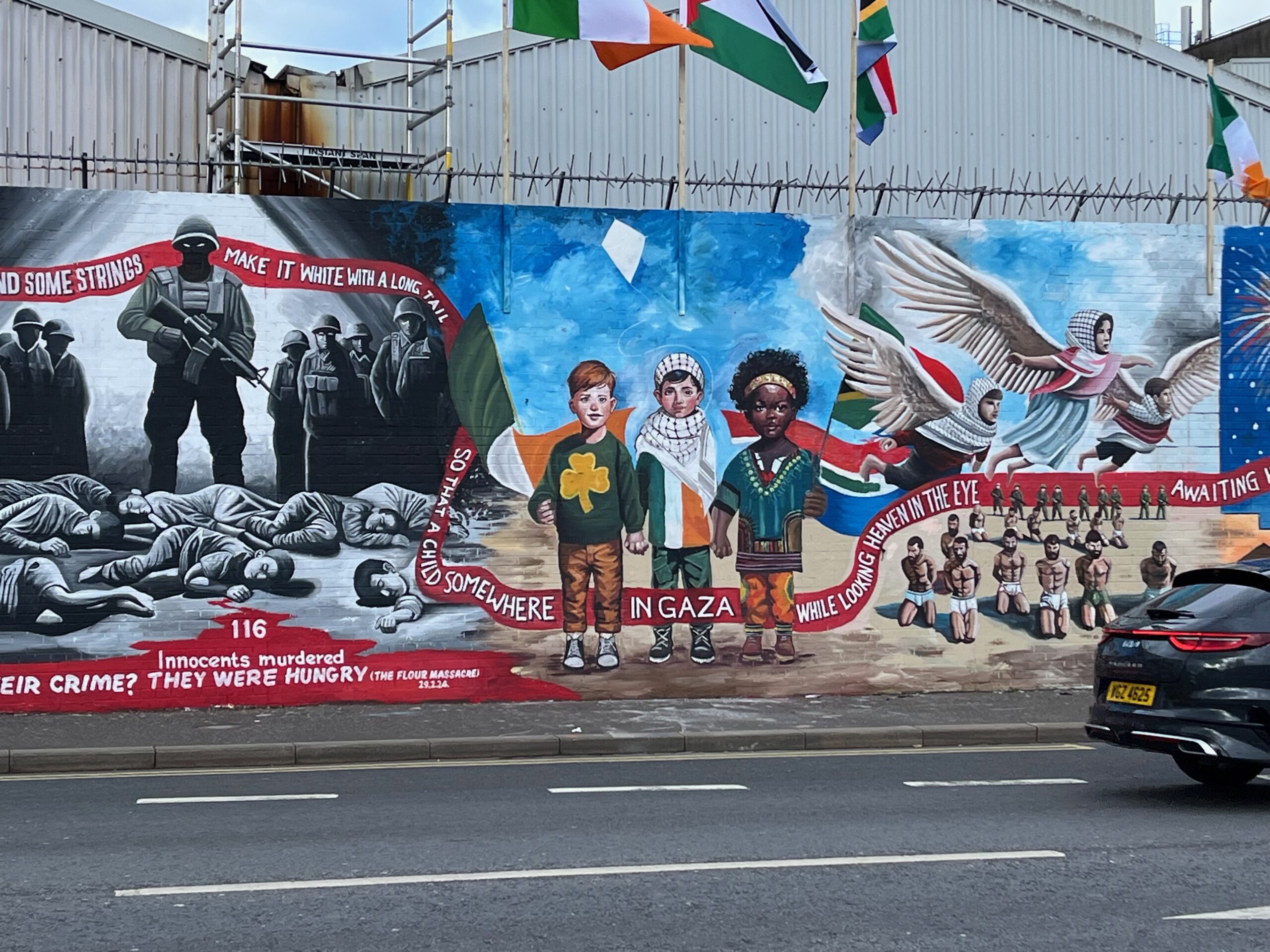
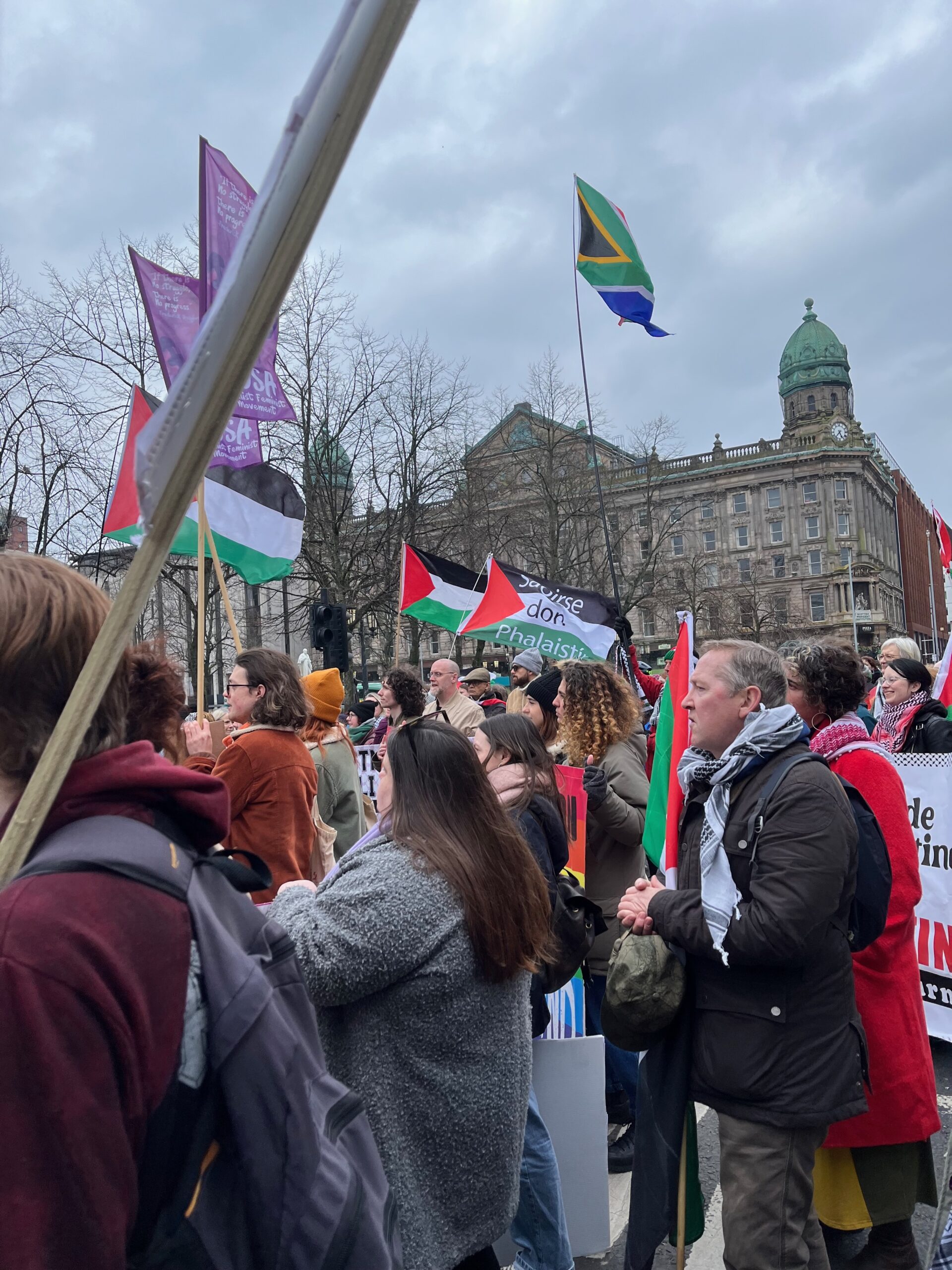
Given the history of Northern Ireland, it’s no surprise that most Catholics (republicans), including the members of Kneecap, are sympathetic to the Palestinians. When I was in Belfast in the Spring of 2024, it was common to see Palestinian flags hung on buildings or painted on walls. There were pro-Palestine marches every Saturday in the city center. The Belfast City Council even won a majority vote to fly the Palestinian flag over Belfast City Hall for the UN International Day of Solidarity with the Palestinian People.[12] In the fall of 2025, there were simultaneous demonstrations in London and Belfast supporting a British pro-Palestinian network (Palestine Action).[13] Although both protests were peaceful, demonstrators were arrested in London, but there were no arrests in Belfast.[14]
Kneecap frequently speak out against Israel’s actions in Gaza, often leading crowds in chants of “Free Palestine” at their shows.[15] Did they pave the way for more tolerance in Belfast? Maybe. But they’ve been under scrutiny as well. In May 2024, they got into hot water by waving a Hamas/Hezbollah flag on stage. The trio says it was thrown on the stage and they just picked it up. Based on their drug and alcohol use prior to performances (if the movie is any indication), I could see them waving a “Kneecap Sucks!” flag if someone threw it on stage. Our lads publicly deny supporting Hamas or Hezbollah, although it’s possible that in the thrill of the moment, they may have waved that flag a little.
Whether it was the alleged support of Hezbollah or support of Palestine in general, the UK government claimed an act of “terror” under British laws. First, the government denied Kneecap a music grant they had been given. The group sued and won a discrimination case resulting in the group getting the full grant amount. (They gave the money to Protestant and Catholic youth organizations in NI.) Second, the U.K. charged Chara under the UK’s Terrorism Act 2006 for the Hezbollah flag incident, forcing the band to cancel sold-out U.S. concert dates.[16] In turn, Canada and Hungary banned them from entry.[17] The terrorism charges were later dismissed by a court because the prosecution missed a filing date. (Perhaps this was a move by the UK to tactfully avoid a potential publicity nightmare.)
It didn’t stop there. Last summer, Kneecap was scheduled to appear at the Glastonbury Festival in England. When the U.K.’s Prime Minister Keir Starmer said the band’s performance would be “inappropriate,” Kneecap replied, “You know what’s ‘not appropriate’ Keir? Arming a fucking genocide.”[18] Kneecap played to a full capacity crowd at “Glasto” although the British Broadcasting Company (BBC) refused to show it live. An attendee livestreamed the concert on TikTok and received 1.8 million “likes.”[19]
Will Kneecap and their Humor, Sex, Drugs, and Rock ‘n’ Roll Help to Bring a Unified Ireland?
The vision among republicans is to unite Northern Ireland and the Republic of Ireland, eliminating British rule everywhere on the island. (Or as one member of Kneecap wrote on his butt cheeks and displayed at a concert, “Brits Out.”) But the issues can be complicated and sometimes opinions are simply based on practicalities. For example, I was told by some people in Belfast that a united Ireland would mean that NI residents would no longer have access to the UK’s National Health Service. The possibility of having less access to quality health care could discourage support for unification.
A poll taken a year ago showed that a referendum to unify Ireland “would be soundly defeated in the North and pass comfortably in the South [Republic of Ireland].” Looking at just the Northern Irish, the poll showed 48% of NI respondents said they would vote to remain part of the UK, 34% said they would vote for unification, and 14% said they didn’t know. The results were split along the expected lines with NI Catholics much more likely to vote for unification and NI Protestants more likely to support remaining in the UK. However, the same poll showed that the resistance to unification seems to be softening over the years.[20]
I like to imagine the future of Northern Ireland sort of like Georgia and Mo’s relationship in Kneecap. Georgia is Protestant, fiercely independent and intent on doing things on her own terms, despite the objections of her peeler (cop) aunt. Chara is loyal to the republican cause and understands the sacrifice of his parents but he’s still drawn to Georgia no matter what the peelers do to him. Theirs is an uncomfortable, unsteady love, full of challenges. If Georgia and Mo can make it work, maybe the north of Ireland can?
The Movie:
Kneecap (2024). Currently on Netflix (free with subscription), Apple TV, Amazon Prime, or Fandango at Home ($3.99 rental).
Other Good Watches:
Belfast (2022). Kenneth Branagh’s memories of growing up Protestant in the titular city.
In the Name of the Father (1993). Based on the true story of seven Irish people in London who were accused of planting a car bomb.
Hunger (2008). Director Steve McQueen tells the painful story of the IRA members who went on a hunger strike to protest their incarceration.
Once Upon a Time in Northern Ireland (2023). Five-episode documentary series. Catholic and Protestant former combatants talk 25 years after the Troubles.
Say Nothing (2024). Nine-episode series based on the real lives of the Price sisters who participated in actions of the IRA.
[1] I’ll use “Northern Ireland” to refer to the six-county area recognized as “Northern Ireland” on most maps. Many republicans refer to the area as “the north of Ireland.”
[2] Gershon, Livia (29 January 2022). “Britain’s Blueprint for Colonialism: Made in Ireland.” JSTOR Daily. https://daily.jstor.org/britains-blueprint-for-colonialism-made-in-ireland/
[3] Garvey, John (9 February 2026). Personal email communication, Garvey recommends Allen, Theodore W. 1994). The Invention of the White Race. Links to videos and more at https://en.wikipedia.org/wiki/Theodore_W._Allen
[4] I will use the term “loyalist” to refer to the political group associated with Protestants. This is the group that would like to NI to continue to be part of the UK.
[5] “History of Sinn Féin.” Wikipedia. Accessed 13 Feb 2026. https://en.wikipedia.org/wiki/History_of_Sinn_F%C3%A9in
[6] Megacine.co.uk. Accessed 26 February 2026. Próvaís’ age is not widely published, but one source puts him at 36 years old in 2025 and eight years old when the peace agreement was signed. https://megacine.co.uk/dj-provai-from-irish-teacher-to-masked-hip-hop-revolutionary/
[7] Fenton, Siobhan (21 May 2019). “Lyra McKee’s ‘ceasefire babies’ generation hopes to chart a new future for Northern Ireland.” The I Paper. https://inews.co.uk/news/northern-ireland/lyra-mckee-ceasefire-babies-northern-ireland-young-people-293210
[8] You can see and hear the lyrics at https://lyricstranslate.com/en/cearta-right.html.
[9] The Irish language is sometimes called “Gaelic Irish” but “Irish” is much preferred by Kneecap.
[10] Full text of Identity and Language (NI) Act 2022. https://www.legislation.gov.uk/ukpga/2022/45/section/2
[11] Chesler, Josh (26 May 2024). “A night out with Kneecap, Ireland’s political hip-hop rebels”. LA Times. Retrieved 21 November 2024.
[12] Beeson, Olivia (02 Dec 2025). “Armed police at Belfast City Hall amid ‘chaos’ as Palestine flag raised after vote.” The Mirror. https://www.mirror.co.uk/news/uk-news/armed-police-belfast-city-hall-36336620
[13] Brown, Chris (20 January 2026). “Britain calls some anti-Israel protests a form of terrorism. Is it state overreach?” CDC News.
https://www.cbc.ca/news/world/uk-palestine-action-israel-protest-9.7050402
[14] Ng, Ellie (22 Nov 2025). “Daughter of Holocaust survivor among those arrested at Palestine Action protest.” Belfast Live. https://www.belfastlive.co.uk/news/northern-ireland/daughter-holocaust-survivor-among-those-32926244
[15] Saltman, Max (19 September 2025). CNN World, “Irish rap group Kneecap have been banned from entering Canada.” CNN World.
[16] Cramer, Philissa (26 September 2025). “Terrorism charges dropped against Kneecap singer who held Hezbollah flag at concert.” MSN. https://www.msn.com/en-us/music/news/terrorism-charges-dropped-against-kneecap-singer-who-held-hezbollah-flag-at-concert/ar-AA1NmOkc
[17] Saltman, Max (19 September 2025). CNN World, “Irish rap group Kneecap have been banned from entering Canada.” CNN World.
[18] Martin, Amy-Clare (18 June 2025). “Kneecap wear ‘Free Mo Chara’ t-shirts as bandmember in court on terrorism charge over Hezbollah flag.” Independent. https://www.independent.co.uk/news/uk/crime/kneecap-mo-chara-court-westminster-terror-offence-hezbollah-flag-b2772167.html
[19] Bain, Mark (29 Jun 2025). “‘Helen from Wales’ hailed ‘hero of free speech’ after live stream of Kneecap reaches 2 million.” Belfast Telegraph.
[20] Leahy, Pat (07 Feb 2025). ” Support for Irish unification growing in Northern Ireland, poll finds.” The Irish Times.