
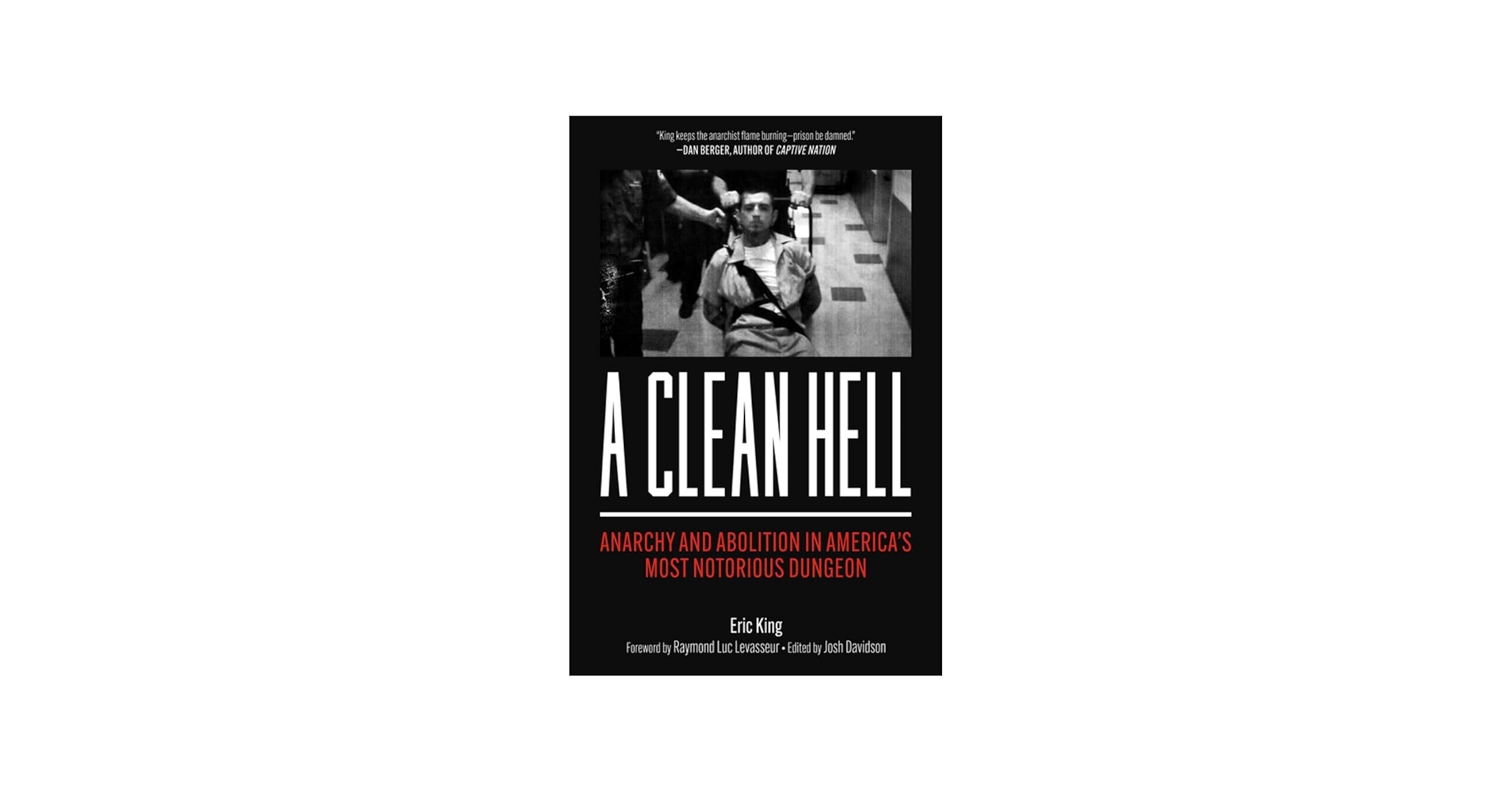
“These jellyfish deserve no respect,” writes Eric King, “and you won’t give them any. You know they will hold you down seven-on-one and have a party while they beat you up. You know that your possessions will be destroyed. That your skin will be burned, that your body will be broken. It doesn’t matter at that moment. All that matters is that you’ve had enough.”
Eric King spent almost ten years as a federal prisoner. King was arrested in 2014 for an attempted arson conducted in Kansas City in solidarity with the people of Ferguson, Missouri following the police murder of the teen-age Mike Brown. King’s actions caused little damage — the molotov cocktails failed at their task — and harmed nobody. But King’s unrepentant anarchist politics, and attendant recalcitrance in the face of his captors, led to his incarceration at ADX Florence, the so-called “Alcatraz of the Rockies” and the last stop for the supposed “worst of the worst” in the federal prison system.
King’s new book A Clean Hell: Anarchy and Abolition in America’s Most Notorious Dungeon (PM Press, 2026) is a welcome addition to the all-too-spare annals of writing on prison by formerly incarcerated people. Building from his experiences, King analytically traces the dehumanization and seeming irrationality of life at ADX back to the violent, racist social order that it was built to uphold. ADX, King argues, is meticulously designed to break the human spirit.
And King, through a narrative that is at once tragic and heroic, demonstrates how the ethical imperative to revolt can be sustained in an environment meticulously engineered to make it impossible.
Upon his arrival, King is struck by the silence of the facility. “I’d thought there would be screaming and rage and resistance and violence and disorder,” King recalls. “I hadn’t realized how empty the units would be. I hadn’t realized it was a tomb.” Rather than speaking simply of his observations of other incarcerated people, King has the courage to discuss the fear and uncertainty this setting produced within himself. “Prison is a scary place,” he writes. “We can posture like it isn’t and pretend that nothing fazes us, but that’s all show.”
In contrast to the machismo that suffuses men’s facilities and can creep into discussions of them, King makes himself vulnerable; he discusses being the victim of sexual assault and multiple horrific tortures, and the ongoing psychological toll these travesties took on him. King is candid about fear, self-doubt, and the struggles he has waged to resist internalizing the prison’s view of him — namely, that he is nothing, and ought to behave accordingly.
At the same time, the most powerful writing in A Clean Hell describes Kings’ struggles against fear, complacence, and victimization. This begins with the very act that led to his incarceration. King’s actions were part of a political moment revolved around the figure of refusal: the refusal of Trayvon Martin to stand down when racially profiled by amateur cop George Zimmerman, the refusal of Michael Brown to acquiesce when real cop Darren Wilson ordered him to “get the fuck on the sidewalk,” the refusal of Eric Garner to be bullied by a gang of New York cops, captured in his words: “This stops today!” In all three cases, and many others, those who refused paid with their lives, but the movement that took up their names carried on their belligerent spirit of negation in the face of overwhelming odds.
“I was so sad that there would be no community justice for Michael Brown’s family,” reflects King, “and I knew that the vilifications of both him and Ferguson as a whole would continue to let the police off the hook… My heart was so clear that serious action was necessary and was the only appropriate action.” King does not aggrandize his resistance. He simply explains himself. As an anarchist, dedicated to human emancipation and ethically committed to solidarity, he witnessed a grave injustice. All around him, people were either ignoring the issue, or vilifying the victims. From his perspective, there was nothing to do but take bold, decisive action; he didn’t have a choice.
As a prisoner, King remained faithful to these values. Subjected to daily indignities at the hands of guards, he could have simply kept his head down. But to King, it was unacceptable to let these sadistic bullies, who typically only discovered their courage in packs, claim victory. Instead, he set out to ring every bell. He insulted guards, identifying their weaknesses and riding them into the ground. In one fateful instance, he drew an image of a guard that was interpreted as a threat — it did, in fairness, show the man’s tombstone with his death occurring in the current year — and in another, accepted the invitation of much larger guard to duke it out, one on one, in a broom closet. For the drawing, King was transferred to higher security. As for the fight, he committed the unpardonable sin of winning it, and his problems were just beginning. King was gang beaten, and for almost eight hours was “four-pointed,” a ghastly medieval torture method that involves stretching one’s limbs to their breaking point. King then faced criminal charges alleging he had attacked the guard, unprovoked.
Facing decades on top of his sentence, King was offered a plea. He turned it down, however, demanding a jury trial. It is impossible to overstate how rarely incarcerated people take assault cases to trial, much less how often they are found innocent. The cultural worship of cops and guards in the United States makes it incredibly difficult for anyone, much less a convicted felon, to successfully contradict even the most perjurous testimony by a person in uniform — or, as cops call it, “testilying.”
King, however, refused to plead to something he did not do. He battled with his own lawyer, and ultimately did what virtually every lawyer would call the essence of naivety: taking the stand in his own defense to simply tell the truth as he saw it. But speaking from the heart about his politics, his life, and the fight as he experienced it, King managed to convince a Denver jury to believe the word of a man — who could be reasonably described as an anarchist arsonist with face tattoos — over a federal prison guard. The charges were dropped, but King would experience brutal, informal retaliation for the rest of his time inside.
A published poet, King’s most lyrical passages revolve around resisting the predation of guards, which greatly increased following his fight in the broom closet. In the process, King develops a kind of sociology of violence against guards — including those that prison managers would call “unprovoked.” “These acts aren’t impulsive violence,” King writes. “This is well-calculated, thought-out, justified violence. This is a thing of beauty. A brutalist art form.” King rattles off the consequences: years added to one’s sentence, being beaten into oblivion, and all manner of retaliation lasting years. “It’s always worth it,” he concludes. “Striking down your torturer is never an act of violence but instead an act of self-dignity and self-preservation. Radical self-love in defense of your humanity.”
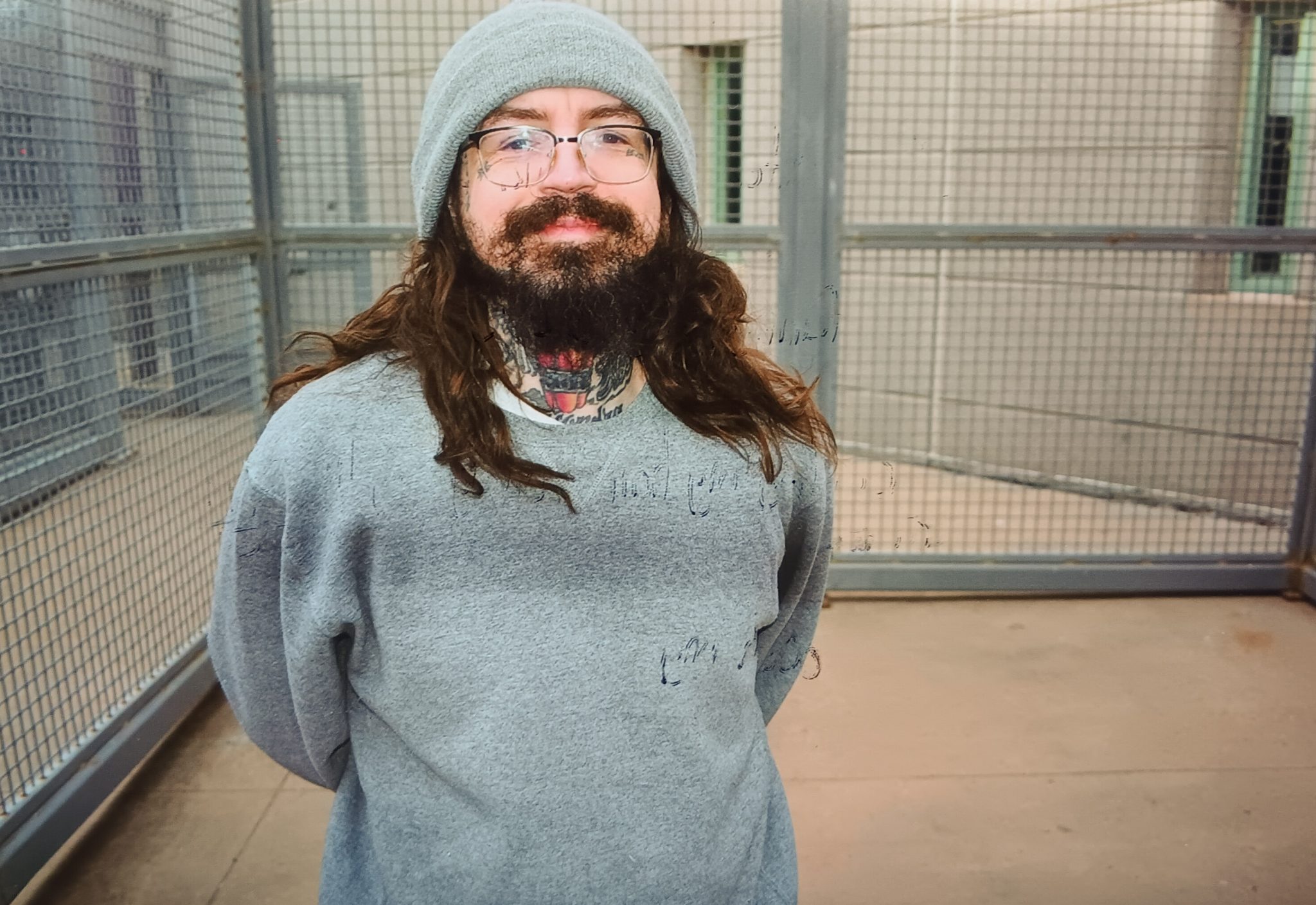
Drawing on his own experiences, King narrates in great detail the process of “running the team.” This means the refusal to leave one’s cell when instructed, which sets into motion an incremental “extraction process” by an elite team of headcrackers clad in riot gear. After negotiations — largely staged for a camera, King writes — the guards deploy a series of increasingly brutal techniques. These range from spraying a variety of chemical weapons, to detonating a stun grenade in the small concrete cell, and ultimately, to flooding the cell and subjecting the incarcerated person to prolonged torture, as King himself experienced on numerous occasions.
“You will not win against seven of the largest officers available,” King assures the reader, “but you’ll have won the mental battle. They couldn’t scare you. They couldn’t break you. You have nothing left to prove… No matter how much your body burns and aches, they can never take that victory away from you.” Alternatively, King celebrates those who go through the whole charade, forcing the guards to suit up, plan their assault, stage, and negotiate — only to capitulate at the last minute and spare themselves the torture. “That is still resistance,” King insists. “Hilarious, anticlimactic resistance.”
Beyond these spectacular scenes, King also describes the everyday resistance he carried out by refusing to abandon his anarchist politics, and specifically, his identity as an avowed anti-fascist. As King recalls, he went to federal prison expecting a “revolutionary university… class solidarity, and anti-police unity.” In reality, he experienced a world riven with many of the same persistent prejudices and divisions that stratify the world outside, only amplified and super-charged with even more violence. “The guards hate race traitors,” King reflects, “the prisoners hate [cross-]racial solidarity, and they both hate LGBTQ folks… If you stand for something leftist, you will face many challenges.”
King took these challenges on. His identity as an antifascist singled him out in the eyes of guards and prisoners alike, especially after Donald Trump began speaking of “Antifa” as a singular, all-powerful terrorist organization. King was challenged on his anti-fascism, and refused to back down. In response, he suffered multiple brutal attacks. King similarly refused to back off his solidarity with queer and trans people, in what is possibly the most phobic setting on earth. King considered his politics his ethical grounding, and was willing to weather whatever it took to stay true to them. And on his final day of incarceration, he walked out of ADX, having never compromised, wearing a shirt that read: “Protect Trans Kids.”
Readers looking to King for a how-to guide for waging prison rebellion, or revolt of any kind, really, will come away from A Clean Hell disappointed. King is the first to admit that virtually all of his efforts came to naught. But they’d be missing out on something perhaps more profound. Eric King articulates an ethical basis on which a committed person can keep fighting as the risks multiply, the proverbial night darkens, and the end of it all remains nowhere in sight. In other words, A Clean Hell provides the perfect opportunity to reflect on the unique problems of our dark historical moment.
Facing rising fascism alongside environmental ruin, with no serious alternative hitherto articulated, the honest friend of human emancipation finds today no clear path forward. In the US, the dangers of resistance seem to rise in inverse proportion to any certainty that it will succeed. ICE and other agencies of brute repression bloat with unprecedented funding, untethered from virtually any outside oversight. Cases like the Prairieland 19 inch us closer toward mass crackdowns on anyone to the left of Obama — and possibly the man himself.
Anyone seeking to struggle on the basis of a cost/benefit analysis will probably see this moment as a great time to lay low. But as the streets of American cities increasingly resemble the corridors outside Eric King’s cell at ADX, packed with thugs dripping with surplus military gear and chemical weapons, eager to crack heads, mass resistance is nonetheless mounting. Just as King waged resistance inside the most militarized prison in the US, so too can we fight on the streets being remade in its image. There is no assurance of victory, and the dangers are greater all the time. But people are still fighting.
As we prepare for at least three more years of Trump, plus whatever horrors are to come next, strategic questions are surely paramount. Interventions on the anti-deportation movement, or the anti-Trump resistance more broadly, such as this piece recently offered by the Lake Effect Collective in my own city, are vital. “Tactics without strategy,” as Sun Tzu reminds us, “is the noise before defeat.”
At the same time, as the stakes rise, strategic questions must be weighed alongside existential ones — as existential questions become a key basis upon which strategies stand or fall. No strategy is assured success, and any struggle involving a modicum of risk will entail countless leaps of faith on behalf of their participants. Meanwhile, those who wait for a safe victory will wait forever.
This challenges us to consider the ethical domain of politics, where a conscientious person must confront their own uncertainty, frailty, and ultimately, mortality, before taking action. It need not conjure morbid thinking, but simply a realistic assessment of what one wishes to get out of life — and what exactly is worth putting it on the line. Eric King certainly did not invent these calculations, but has taken them further than virtually everyone in our movement who lived to tell the tale.
Life, King argues, is “a beautiful opportunity”: “We have the chance to resist. We have the chance to say no to evil. We have the chance to extend love to those who are in need and a fist to those who are deserving.” And whether or not he intended it, King has crafted an ode to righteous revolt, waged not because one can see a clear end, but as a style of living, in and for itself.
Jarrod Shanahan is an associate professor of criminal justice at Governors State University, and the co-author of City Time: On Being Sentenced to Rikers Island (NYU Press, 2025) and other books.